By Todd C. Frankel and Federica Cocco | The Washington Post on March 21, 2026
The new head of Ram trucks was confident, defiant, when he announced the return of the legendary, powerful, gas-guzzling Hemi engine.
“Ram screwed up when we dropped the Hemi — we own it and we fixed it,” chief executive Tim Kuniskis said.
The Ram website was more blunt: “**** YEAH, THE HEMI V8 IS BACK.”
The 2026 Ram 1500s equipped with the legendary V-8 engines get only 12 to 19 miles per gallon, making them among the least fuel-efficient of any new vehicle, according to Energy Department data.
But when the decision to revive the Hemi was announced last summer, national gas prices were averaging just $3.02 a gallon and on their way down to $2.70 by year’s end. The political winds were favorable — the Trump administration was moving to water down fuel efficiency standards. And Ram executives figured Americans would put the engine’s roar ahead of any worries about miles per gallon.
Now, though, the math looks very different, for both automakers and drivers.
The Iran war has pushed up gas prices about 33 percent in just three weeks, adding nearly $1 to the average gallon. This week, the nationwide average gas price hit $3.91 — the highest in almost four years.
With the International Energy Agency calling the war “the largest supply disruption in the history of the global oil market,” most experts don’t expect prices to come down soon.
Regular gas averaging $4 per gallon seems certain in the coming weeks, experts say.
“It’s more like a ‘when’ than an ‘if,’” said Patrick De Haan, petroleum analyst at GasBuddy.
A $4 national average would mean $5.79 a gallon in California, a state with among the highest prices, and $3.34 in a cheap-gas state such as Kansas. Gas prices vary depending on state taxes and fees, fuel blends and the distance from refineries.
Even $5-a-gallon average — last seen briefly in June 2022 — could be on the table for later this year.
That could hit the drivers and makers of American-brand vehicles especially hard.
U.S. automakers have among the least fuel-efficient lineups on the road, making them more vulnerable to gas-price shocks, according to a Washington Post analysis of government fuel economy data.
The new 2026 lineups from Ram, Dodge, GMC and Chevrolet have combined MPGs that are worse than any auto brand except a handful of luxury titles, such as Ferrari and Rolls-Royce.
American companies, more so than their European or Asian counterparts, have largely turned away from producing small cars in favor of what U.S. customers have shown they want to buy: crossover SUVs and trucks. It’s one reason that the average price for a new automobile is now above $50,000. The $20,000 entry-level car is gone. Affordability is a growing concern, especially as the used-car market remains tight and prices high.
That fuel efficiency gap translates directly into pain at the pump. At today’s prices, an average Ram driver spends roughly $600 more a year on fuel than an average Honda driver, and the difference only grows as prices rise.
The Post analysis shows how much the price spike is already costing drivers, depending on which brand they drive. Owners of the least efficient U.S. brands — Ram, GMC and Dodge — face annual fuel bills roughly $800 to $835 higher than before the war began.
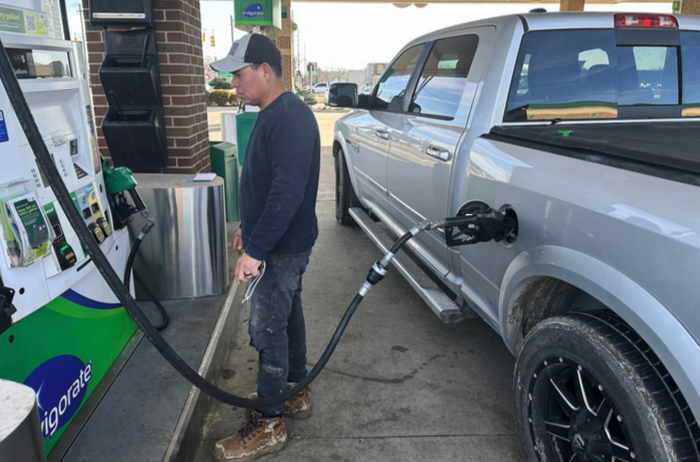
Drivers everywhere have started to bemoan the higher costs. Among those sharing gas pump shock photos are the members of a Facebook group for owners of Ram 1500s equipped with what’s called a “mild hybrid” to boost fuel efficiency. One poster, from Texas, said he avoided topping off his tank “because I saw my mortgage amount due.” Others talked about avoiding driving as much as possible — or using their spouse’s car.
The move to bigger, thirstier vehicles got a boost from President Donald Trump, who gutted the federal push for greater fuel efficiency when he took over the White House. His administration reined in what it derided as the “EV mandate.” The EV tax credit program expired in September. Federal fuel efficiency standards were reset with softer targets. The Environmental Protection Agency recently announced plans to reduce regulatory pressure for better fleet efficiency.
But automakers also need gas prices to stay low.
“It is befuddling” that gas prices are now galloping upward under Trump, said De Haan, because the president has often touted low gas prices.
Just four days before bombing Iran, Trump in his State of the Union address last month said gas prices had been “a disaster” under President Joe Biden. He said gas was now under $2.30 a gallon in most states. “And when I visited the great state of Iowa just a few weeks ago,” he continued, “I even saw $1.85 a gallon for gasoline, the lowest in four years, and falling fast.”
“It’s a very different story now,” De Haan said.
“He went from, ‘Oh hey, Iowa, $1.85,’ to ‘Oh hey, Iowa, we’re closing in on $4,’” De Haan said.
High gas prices can influence what kind of vehicles people want to buy.
“If gas prices continue to increase with no end in sight — if this is the new normal — I think consumer behaviors will have to change,” said Abey Abraham of consulting firm Ducker Carlisle, where he leads its automotive and materials practice.
In the mid-2000s, gas prices roughly doubled from about $2 to $4 a gallon as demand surged. Sales of the biggest pickups fell. The Ford F-series — including the F-150, the perennial best-selling automobile in the U.S. — saw sales drop by about 45 percent as consumers shifted toward smaller vehicles and hybrids like the Toyota Prius.
Gas prices spiked again, nearing $4 a gallon, coming out of the Great Recession, but pickup sales softened only briefly.
Truck sales also dipped when national gas prices clipped $5 a gallon in 2022, after Russia’s invasion of Ukraine. But sales took off again as prices eased.
Today, the impact could be more muted, at least in the short term.
Consumers have become so enamored with SUVs and trucks — and there are fewer fuel-sipping sedans to choose from — that they may still buy a truck, experts say. But they may choose a model with better gas mileage, such as going with two-wheel-drive or a hybrid.
“If that auto brand doesn’t have the power train they’re looking for, they might look around at others,” said Erin Keating, executive analyst at Cox Automotive. “Do they ultimately need to have a Hemi engine, or can they go with something more fuel efficient?”
Hybrids are the most likely beneficiary of any shift away from pure gasoline engines, analysts said. Electric vehicles will continue to see growth, but sales will be constrained by EV’s higher sticker price and the loss of subsidies.
The bigger worry for automakers is that high gas prices tend to deflate consumer confidence, Keating said.
Potential car-buyers just might decide not to buy any vehicle while gas prices and uncertainty are high.
“They get more nervous about big-ticket purchases,” she said. “And if you’re the automaker, this is just one more thing that consumers are feeling down about.”
Source URL: https://www.washingtonpost.com/business/2026/03/21/gas-prices-miles-per-gallon-iran-war/