Energy Transition + Data Centers = Opportunity
11. 13. 25Two reports compiled by Ducker Carlisle indicate abundant opportunities for electrical engineers, manufacturers, and distributors in the coming years. Here’s an exclusive interview.
Tech Insights by Karen Hanson
The global transition to renewable and clean energy, combined with rapid data center development, is creating a perfect storm of opportunity for power electronics manufacturers and distributors, according to two Ducker Carlisle reports. However, making strategic decisions requires knowing which energy industries are growing and which are slowing.
The 2025 Global Energy Transition Outlook pinpoints data centers and AI applications as key drivers of renewable and nuclear energy worldwide while identifying challenges. The second report Ducker Carlisle prepared for the National Association of Electrical Distributors highlights which areas distributors can target in planning future strategies.
EEPower spoke to Kevin Sarb, Ducker Carlisle Managing Director, about how industry leaders can identify the trends and prepare for possible challenges. Erika TenEyck, Director of Business Intelligence Programs and Insights at the National Association of Electrical Distributors (NAED), weighed in by email.
Both reports project significant growth and decreasing costs in renewable energy, with opportunities in data centers, industrial electrification, microgrids, and grid capacity electronics.
What does the future hold for the power industry? Image used courtesy of Adobe Stock
Report Insights
The 2025 Global Energy Transition Outlook predicts that renewable energy will surpass fossil fuel sources by 2035, with solar photovoltaic and wind predominating and nuclear energy growing in importance. At the same time, electricity demand will increase significantly by 2050, with data centers as the primary driver. However, grid modernization efforts, energy storage development, and governmental policies could influence the projections. The electronics industry will continue to face issues with supply chains, financing, and grid delays.
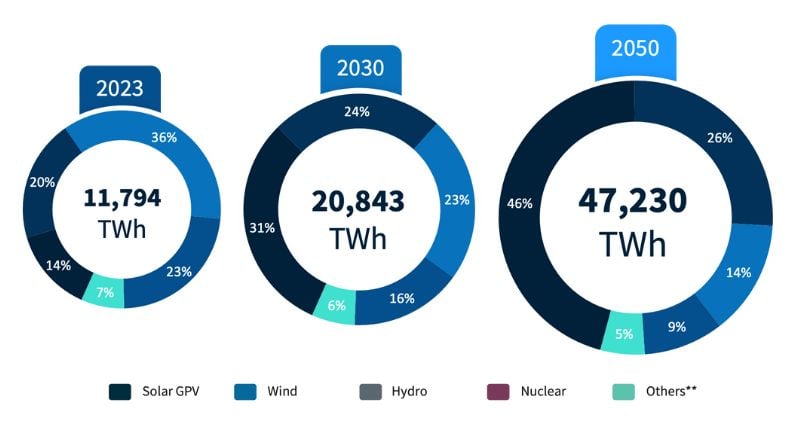
The global energy transition by 2050. Image used courtesy of Ducker Carlisle
Ducker Carlisle prepared the second report, Electrification Drivers, Disruptors, & Scaling Your Business, for NAED to provide insights into trends in the electronics market. This study also predicts growing demand and examines market changes, such as the opportunities in small, medium, and large-scale projects. The report points out that electrification projects are growing in complexity, requiring distributors to be creative in meeting needs in the value chain. It also recommends that distributors target specific sectors and prioritize their expenditures.
Meeting Data Center Challenges With Clean Energy
Data center power demand will continue to drive the most opportunities and challenges through 2030, according to the Energy Transition report. In the U.S., data center electricity demand will increase by about 400 TWh. In China, data centers are projected to use about 380 billion kWh of electricity by 2030.
Data center developers are meeting the need through both utility-scale energy and microgrids. Data centers need energy quickly, and many are willing to create their own energy generation infrastructure.
“The demand is huge at the moment, and we expect it to continue,” Sarb said. “Eventually, they’ll all be connected to the grid, but utilities are slow at moving capital and getting investments up and running, certainly not at the pace of Google or Amazon might want to move, and they’re finding ways to say, ‘We need energy now’.”
At the same time, governments and companies have set clean energy goals. While these goals may not be on track to meet net-zero, they are making significant progress, with renewables or clean energy projected to generate about 80% of all electricity by 2050. These numbers represent the most likely scenario, but policies and conditions could change them, Serb cautioned.
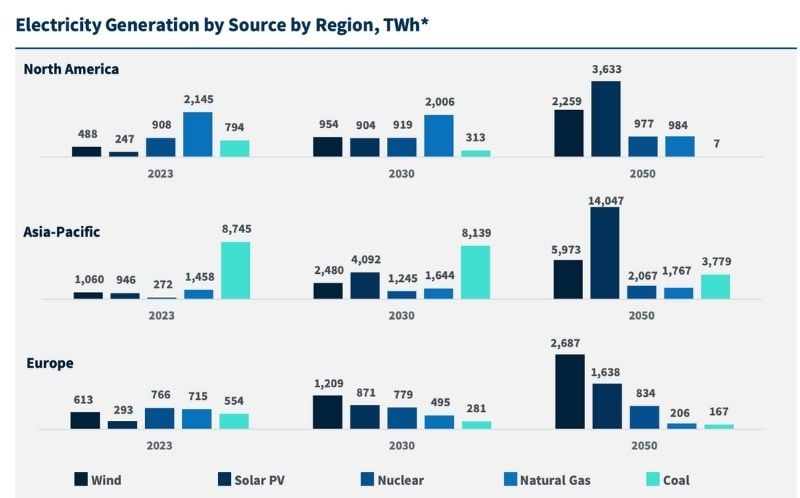
Renewable energy growth by 2050. Image used courtesy of Ducker Carlisle
The Energy Transition report included nuclear as a clean energy source since it is emissions-free and noted that “a new generation of large-scale nuclear reactors is being built in several countries with enhanced features.” Small modular reactors are also developing quickly. However, Serb pointed out that many questions about nuclear energy remain.
“It still takes time to develop from scratch a nuclear reactor, even at a micro scale, to be deployed,” he said. He added that two major uncertainties are regulations and the supply chain, particularly for uranium.
While no one knows when data center development will reach its peak, opportunities for power electronics companies will always exist in ongoing operations and maintenance, Serb said.
“There’ll be upgrades and refreshes of these data centers every three to five years,” he said.
Supply vs. Demand: It May Not Be What You Think
Contrary to popular opinion, grid capacity is keeping up and even outpacing demand, according to the NAED report. However, electronics distributors should be aware of significant regional differences.
“Most of the big utilities out there are talking about modernizing their grid or have that in their capital investment plans for the coming years, at the pace utilities can move,” Sarb commented, adding that the bigger issue is that certain areas will be better able to handle future loads than others.
The challenge is localized because certain areas will have the capacity to add more data centers and other electrification, but others will be less prepared.
“The question is, is the overall grid fit? Do we have the capacity or generation capacity to handle it?” he said.
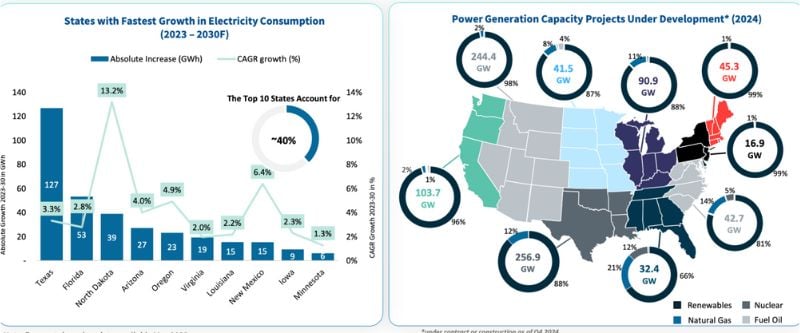
Regional differences in consumption and capacity. Image used courtesy of NAED
For electronics distributors, these variations will require careful investigation.
“It’s important to evaluate the types of projects that are poised for growth in your area and understand how they may intersect with the products and services a distributor currently offers,” TenEyck commented. “From there, a distributor’s team should prioritize those opportunities based on the value and risks/investments required—how far are they willing to venture from their core areas? Too, it’s important to be selective about those opportunities and decide what makes the most sense for their companies and resources.”
The report also advises distributors to collaborate with manufacturers and project developers about the new technologies, services, and strategies required as the energy industry grows and changes.
“For example, electrification in an industrial building could lead to upgrading legacy systems from gas-powered equipment to electric, integrating energy storage, or optimizing for renewable power sources,” TenEyck stated. “A manufacturer–distributor partnership could be crucial here to help ensure the solutions work efficiently, safety needs are met, and performance standards are in place.”
Engineering the Future
Sarb said the takeaway from the reports is that anyone working in power electronics must be aware of the changes and adapt to them.
“If you’re an engineer with a company that serves this [industry], utilities or the electric or energy space, these are different projects than maybe what we traditionally served,” he said. “If we’re talking about renewable installations, small nuclear for data centers, or whatever it is, that just shifts how we behave.”
Source URL : https://eepower.com/tech-insights/reports-energy-transition-data-centers-opportunity/#